You lift a painting estimate close rate by changing what the homeowner is comparing, not by shaving your number. Two proposals land on the same kitchen counter. One is a price. The other is a plan. The page a homeowner can actually read is the page that wins, and it wins plenty of times at the higher number.
I've talked with a lot of painting owners who swear they lost a repaint on price. Then I ask to see the bid they sent. It's a text message with a dollar figure in it. That's not a price loss. That's a homeowner holding two pieces of paper that say the same nothing, so they picked the smaller number. What else were they supposed to do?
The kitchen counter is where the repaint gets decided
Picture the real moment. Friday night, two sheets on the counter, a homeowner and a spouse standing over them. Yours says $6,200. The other says $4,800.
Watch what they do next. They don't debate paint chemistry. They scan both pages for anything that makes the two different. If both pages are just a number and a signature line, the lower number wins in about eleven seconds.
So the job isn't to be the low-cost page. It's to be the only page with information on it. The FTC flat out tells homeowners to get the scope of work and the cost of labor and materials in writing before they sign anything. Most painters hand over a number and hope. Be the one who hands them the exact thing they were told to ask for.
Your painting estimate close rate is set during the walkthrough
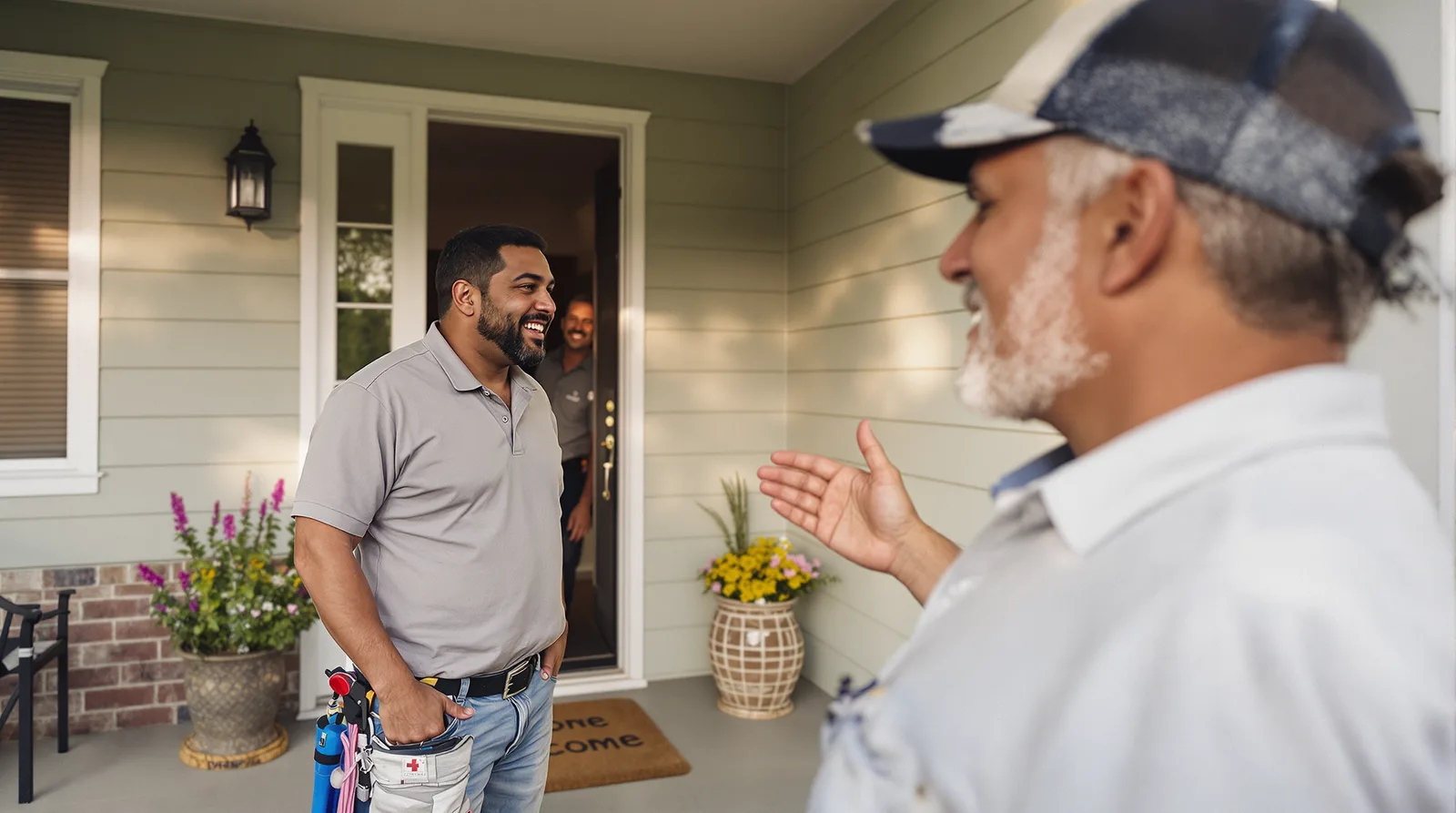
By the time you hit send, the decision is mostly made. The walkthrough is where you either became the expert on that house or became the second guy who measured the living room. Same forty minutes, wildly different outcome.
Here's what I watch the strong closers do on the walk. It costs about eight extra minutes.
- Name three specific problems out loud. The nail pops on the south wall. The chalking on the sunny elevation. The bathroom ceiling nobody primed in 2014. Now you're the only bidder who actually saw the house.
- Say what you're not going to touch. "We're leaving the garage alone, and here's why." Exclusions build more trust than promises do.
- Ask what went wrong last time. Every repaint has a ghost. Find out which painter you're really competing against.
- Handle color before you handle price. Homeowners stall on color far more than they stall on cost. Give them a next step and the job keeps moving.
- Set the delivery time in front of them. "You'll have this in your inbox by four today." Then actually do it.
None of that is a sales trick. It's proof you were paying attention, and it's the lowest-cost proof you'll ever produce.
Write the proposal so the low bid looks unfinished
Nothing moves a painting estimate close rate like a document that answers questions before anybody asks them. Your proposal has one job: make the other one look like somebody guessed. Every line you write that the low bid skipped is a question the homeowner now has to go ask the other guy. Most won't bother. They'll pick the one that already answered it.
Put these on the page, in plain English, every time:
- Prep, spelled out. Wash, scrape, sand, caulk, patch, prime. Say how, not just that.
- Coats and product, by name. Two coats of a named line beats "quality paint" by a mile.
- Surfaces in and surfaces out. Trim, doors, jambs, shutters, ceilings, closets. List them.
- Who is in the house. Your crew, your foreman, not a rotating cast of subs the homeowner meets on day one.
- Timeline and daily hours. Start date, working days, when the ladders leave.
- Certifications. On any home built before 1978, the EPA requires lead-safe certified firms. Put your certification number right on the page. Half your competition is hoping nobody asks.
- Warranty, in years and in writing. Two years on labor reads very differently than silence.
This isn't me inventing paperwork for fun. The Painting Contractors Association publishes a full set of industry standards for exactly one reason: scope arguments. A vague bid is a change order and a bad review waiting to happen. A specific bid is a sales document that keeps working after you drive away.
Nothing to compare but the price
One number, one signature line. The only lever left is going lower, and the next painter through the door just has to write a smaller figure than yours.
Seven reasons to pick you
Prep, coats, product, crew, timeline, certification, warranty. Every line the low bid is missing turns into a question the homeowner has to go ask somebody else.
The bid that shows up Thursday already lost
Homeowners call two or three painters in one sitting. They're not running a procurement process. They're trying to be done thinking about their house.
Harvard Business Review's audit of 2.24 million leads found that firms making contact within an hour were roughly seven times likelier to reach a decision maker. That study was about the first call. The same clock runs on the proposal. Every day your number sits in a drafts folder, somebody else's number sits on the counter.
Same-day written proposals are the fastest fix in this whole article. Build the template once, fill in the blanks in the truck, send it from the driveway. I've written about why the first company to answer wins the job, and the estimate is round two of that same race.
Ten points of close rate, same trucks, same phone
Painters ask me how to get more leads. Fair question. But a lot of you are already standing in enough kitchens. The leaks are downstream, in the bid and the follow up. Your painting estimate close rate is the lowest-cost lever in the whole building, and it costs nothing extra per month to pull it.
Interior and exterior repaints commonly land between $3,500 and $10,000, so $4,500 is a conservative stand-in. Run that math on your real average ticket. The number startles people.
And no, I'm not telling you to stop investing in demand. Buy the leads, run the ads, build the rankings. Just don't pour water into a bucket with a hole in the bottom, because the hole is almost always the estimate.
The follow up that doesn't feel like nagging
Most painters send the bid and go dark, which a homeowner reads as "he doesn't want it that badly." I'd rather you have a script. Three touches, spread out, each one carrying something useful instead of "just checking in."
- Same day, one hour after sending. A text: "Sent it over. Page two has the prep list. Any question on the trim?"
- Day two. Photos of a similar house you finished, plus one review link. Proof beats persuasion, which is why a real review system pays for itself twice.
- Day five. Scarcity that happens to be true: "I'm holding the week of the 14th until Friday, then it goes."
If they still say the other guy costs less, ask one question: "Can you read me his prep line?" Nine times out of ten there isn't one. Now the conversation is about scope instead of dollars, and scope is a fight you win.
What to do Monday morning
Pick one thing. Rebuild the proposal template with the seven items above, or commit to same-day delivery for thirty days. Then track it. Bids sent, bids won, average ticket. A painting estimate close rate you don't measure is just a feeling you have about a slow month.
The 60-second version: homeowners compare documents, not painters. Win the walkthrough by naming real problems. Write a proposal that makes the low bid look unfinished. Get it there the same day. Follow up three times with something useful. Ten points of close rate on the same leads is real money you already paid to go get.
Filling the calendar in the first place is its own project, and I've covered the prep and scheduling side of it in the painting marketing playbook. But the estimate is where the money changes hands. Get more homeowners calling you, then convert more of them with a document that earns the higher number, and both halves of the business move at once.
That's the engine we build for painters: your rankings, your reviews, your booked estimates, in your market alone. The full picture sits on the painting page, the build itself is walked through on how it works, and if you'd rather just find out whether your territory is open, our team can cover it in 15 minutes. Either way, go fix the proposal. It's free, and it's sitting on somebody's counter tonight.
Stop renting your growth. Own it.
We build the whole engine and run it for you, with nothing held hostage. One company per trade, per market.
Book a Discovery Call →